

When asphalt begins to deteriorate, the conventional response is often removal and replacement. But deterioration does not necessarily mean the entire pavement has lost its value.
At Soil Solutions, we start by understanding why the pavement is failing and what can be recovered. Asphalt rehabilitation gives us the opportunity to reuse existing infrastructure, address underlying weaknesses and engineer a renewed pavement system rather than automatically starting again.
The objective is not simply to repair the surface. It is to restore performance and extend the useful life of the infrastructure.
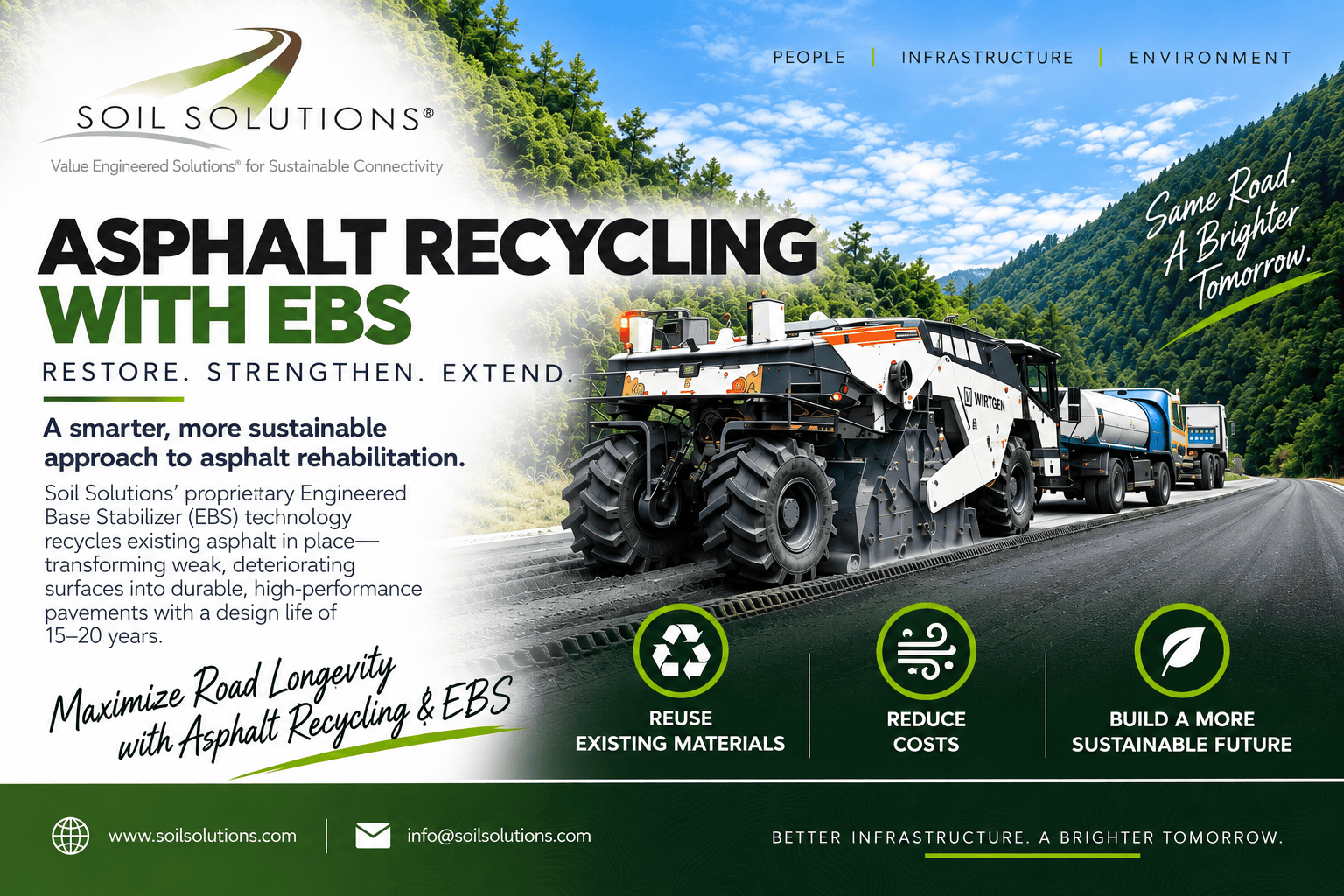
What if the deteriorated road itself could become part of the solution?
Instead of excavating and disposing of existing pavement and importing large quantities of replacement material, asphalt can be recycled in place and incorporated into the rehabilitated pavement structure.
Using EBS as part of the rehabilitation methodology allows existing materials to be reworked, stabilised and reused.
This changes the conversation from remove and replace to recover, re-engineer and reuse.
It is a practical example of what sustainable infrastructure should mean: make better use of the resources already available before bringing in more.
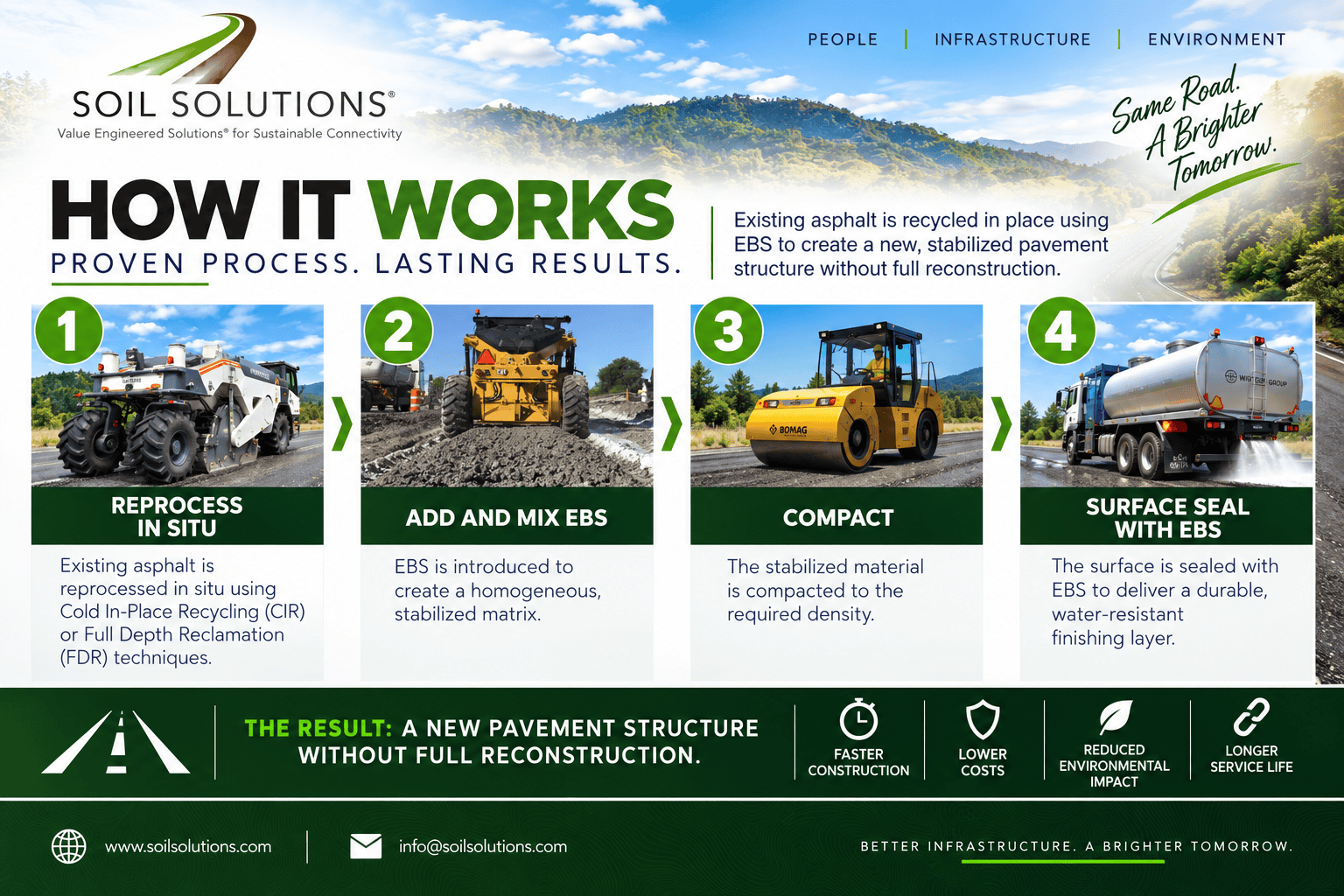
Good rehabilitation is a process, not simply a treatment.
The existing asphalt is reprocessed in situ using Cold In-Place Recycling (CIR) or Full Depth Reclamation (FDR), depending on the pavement condition and project requirements. EBS is introduced into the recycled material, which is then mixed into a homogeneous matrix, shaped and compacted to the required density before the surface is protected with a seal.
The important point is that the methodology is project-specific.
Existing pavement condition, materials, traffic loading, drainage, climate and required performance all influence how the rehabilitation should be engineered.
Understand what has failed. Reprocess what can be reused. Strengthen what remains. Protect what you have rebuilt.

The value of recycling in place extends well beyond the construction process.
RECYCLE. REUSE IN PLACE. REDUCE IMPACT.
Instead of removing deteriorated asphalt and treating it as waste, the existing pavement can be recycled and reused in place as part of the rehabilitated road structure.
This can reduce demolition and removal, material disposal, imported aggregate, truck movements and construction time. Fewer material movements and reduced reliance on new materials can also mean lower fuel consumption and associated CO₂ emissions, allowing rehabilitation to provide a significantly greener approach with less environmental impact than conventional remove-and-replace reconstruction.
But the real measure should be lifecycle performance.
How quickly can the road return to service? How much existing material can be reused? How much new material can be avoided? How much future maintenance can be reduced? And how long can the rehabilitated pavement continue delivering the performance required from it?
This is where recycling becomes more than a construction methodology. It becomes a different way of thinking about the value already contained within existing infrastructure.
Reuse what is already there. Reduce removal. Reduce transport. Reduce waste. Reduce environmental impact. Extend infrastructure life.
Sustainability and economic performance should not be competing objectives. Good engineering should allow us to improve both.
Soil Solutions Intelligent Gravel Roads
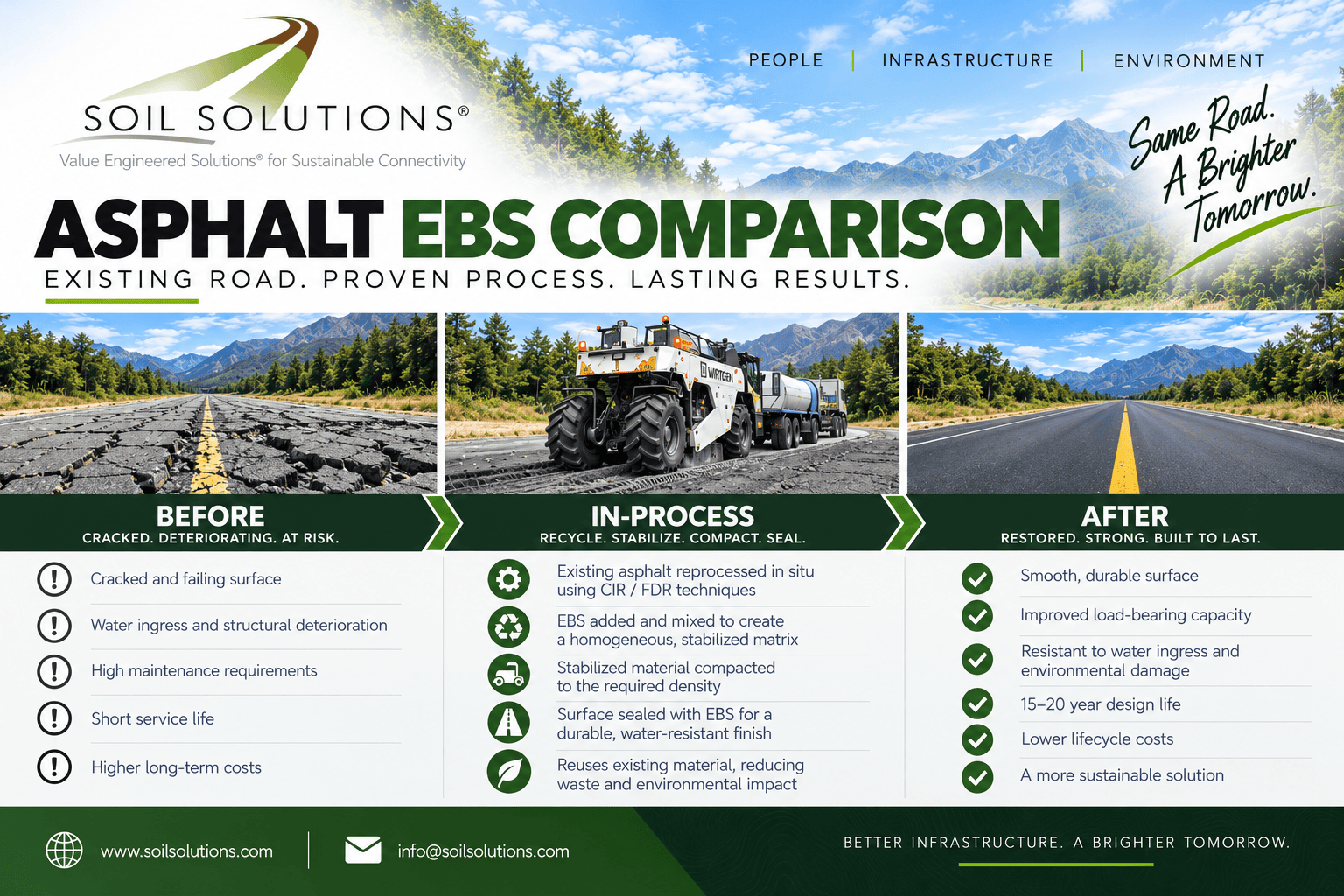
This is where the difference between conventional reconstruction and in-place rehabilitation becomes easier to understand.
On the left is a deteriorated pavement: cracked and oxidised asphalt, weakened underlying material, water ingress and an eroding shoulder.
With a conventional remove-and-replace approach, deteriorated asphalt may need to be excavated, transported from site and disposed of through appropriate regulated waste-management channels. Depending on the jurisdiction and the material involved, this can introduce additional handling, transport, disposal, compliance, time and cost requirements.
Rather than automatically treating the existing pavement as waste, in-place rehabilitation asks a different question:
How much of the existing infrastructure can we recover and reuse?
On the right, the existing pavement materials become part of the rehabilitated structure. The asphalt is reprocessed in place, the material is stabilised and compacted, the profile and crossfall are restored, drainage is considered and the completed pavement is protected with an EBS Surface Seal.
This can significantly reduce the amount of pavement requiring removal and disposal, while also reducing the need for replacement aggregate, associated truck movements and the environmental impact of transporting materials both away from and back to the project.
The important principle is that rehabilitation should address the pavement as a system.
Surface condition, structural material, compaction, shoulders, crossfall and drainage all influence how that road will perform after the construction team leaves.
The opportunity is therefore much bigger than creating a new-looking surface.
Recycle what can be recovered. Reuse it in place. Reduce removal and disposal. Reduce imported materials and transport. Re-engineer the pavement for longer-term performance.
A new-looking surface is not enough. The objective is a better-performing pavement structure beneath it, achieved with fewer unnecessary resources and less environmental impact.