


Intelligent gravel roads
Lower cost. Longer life. Innovative, sustainable roads.
Deliver more kilometres of road from the same budget. EBS roads cost a fraction of asphalt or cement to build, last far longer than conventional gravel roads, and dramatically reduce ongoing maintenance, giving governments and private operators a predictable, lower lifecycle cost.
The engineering behind it: the material already on site is stabilised and sealed with EBS into a bound, water-resistant, dust-free structure, instead of the loose, unbound gravel that erodes and needs constant grading.
Request an Assessment Explore Our Road SolutionsLower
construction cost
Longer
road life
Minimal
maintenance
Eco-friendly,
non-toxic
Conventional gravel vs EBS roads
Conventional gravel road
- Loose, unbound and porous
- Erodes and corrugates with every rain and every vehicle
- Constant grading, watering and re-sheeting
- Maintenance costs keep rising, year after year
EBS road
- Stabilised, bound and sealed
- Hard, water-resistant, dust-free surface
- Minor spot maintenance and periodic resealing
- Lower build cost and a flat, predictable lifecycle cost
Our intelligent road solutions
One technology, applied to the road you have. Choose a solution to find out more.


Green roads
Built for conservation projects
Eco-friendly, non-toxic and biodegradable.
Green Roads are our solution for national parks, game reserves, conservation areas and other environmentally sensitive sites. Unlike conventional bitumen and asphalt surfaces, EBS is non-toxic and biodegradable, and it does not leach into the soil or the water table, so it will not contaminate groundwater or disrupt local ecosystems.
The application process is non-invasive too, limiting disruption to native vegetation and soil and protecting wildlife habitats.

Lower emissions to build. Lower emissions to maintain. No leaching into the water table.
See it in conservation: Limpopo-Lipadi Game & Wilderness Reserve → Sir Baniyas Island →
Why unsealed gravel roads fail
Traditional gravel construction leaves the surface unsealed, so the road starts losing material from day one, and maintenance never stops.

Unsealed gravel road

EBS surface sealed gravel road
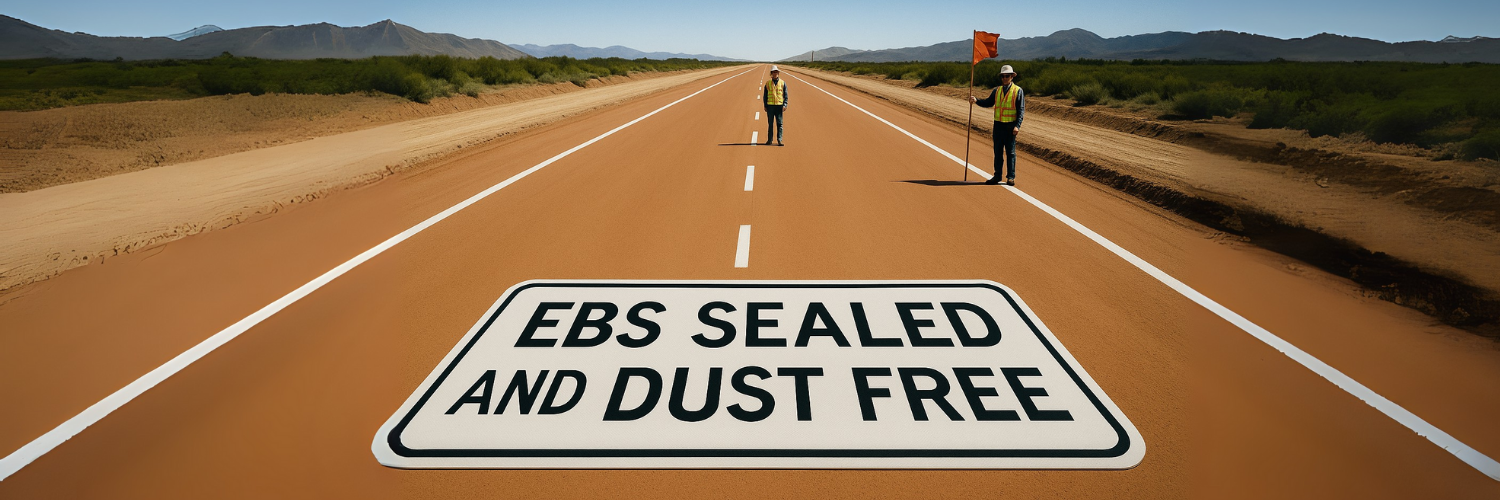
EBS Surface Seal: the smart alternative to asphalt and cement
A road properly treated with EBS has a hard, water-resistant surface with a long-term wearing course, giving reliable access in all weather, at a fraction of the cost of asphalt or cement.
| 1 | Grade and shape The road is graded, shaped and contoured for drainage. |
| 2 | Compact The base is compacted, with EBS stabilisation where the material needs it. |
| 3 | Seal with EBS EBS is applied as a surface seal, creating a hard, dust-free, water-resistant surface. |

Before sealing, natural surfaced finish and black surfaced finish. EBS Surfaced Roads are completely non-bitumen based.
More on Surface SealingBenefits of EBS sealed gravel roads
Stronger roads. Lower costs. Less impact.
For governments and municipalities
Improved roads = connectivity = economic growth
Most countries rely on thousands of kilometres of secondary gravel roads. Population growth, trade and agriculture now demand resilient road networks, but upgrading everything to asphalt is financially out of reach for most budgets.
Our gravel road upgrade programmes help governments deliver more and better roads within existing budgets, improving access to markets, schools and healthcare.
For the private sector
Roads that keep operations moving
The same technology serves private operators who depend on reliable, dust-free access roads.
MINING
Mine haul and access roads
Dust control, lower water use and fewer grader and bowser hours on heavy-traffic roads.
ENERGY
Renewable energy sites
All-weather access roads for wind and solar projects, including the Lake Turkana Wind Power project in Kenya.
ESTATES
Farms, estates and parks
Durable internal roads for agriculture, private estates, lodges and conservation areas.
Project in action
Lake Turkana Wind Power, Kenya
Soil Solutions was awarded the first phase of internal road upgrades at the Lake Turkana Wind Power project. This video shows the first 5 km being built.
The technical detail
For engineers, specifiers and road authorities: how EBS compares, which treatment to use, and how each road is specified.
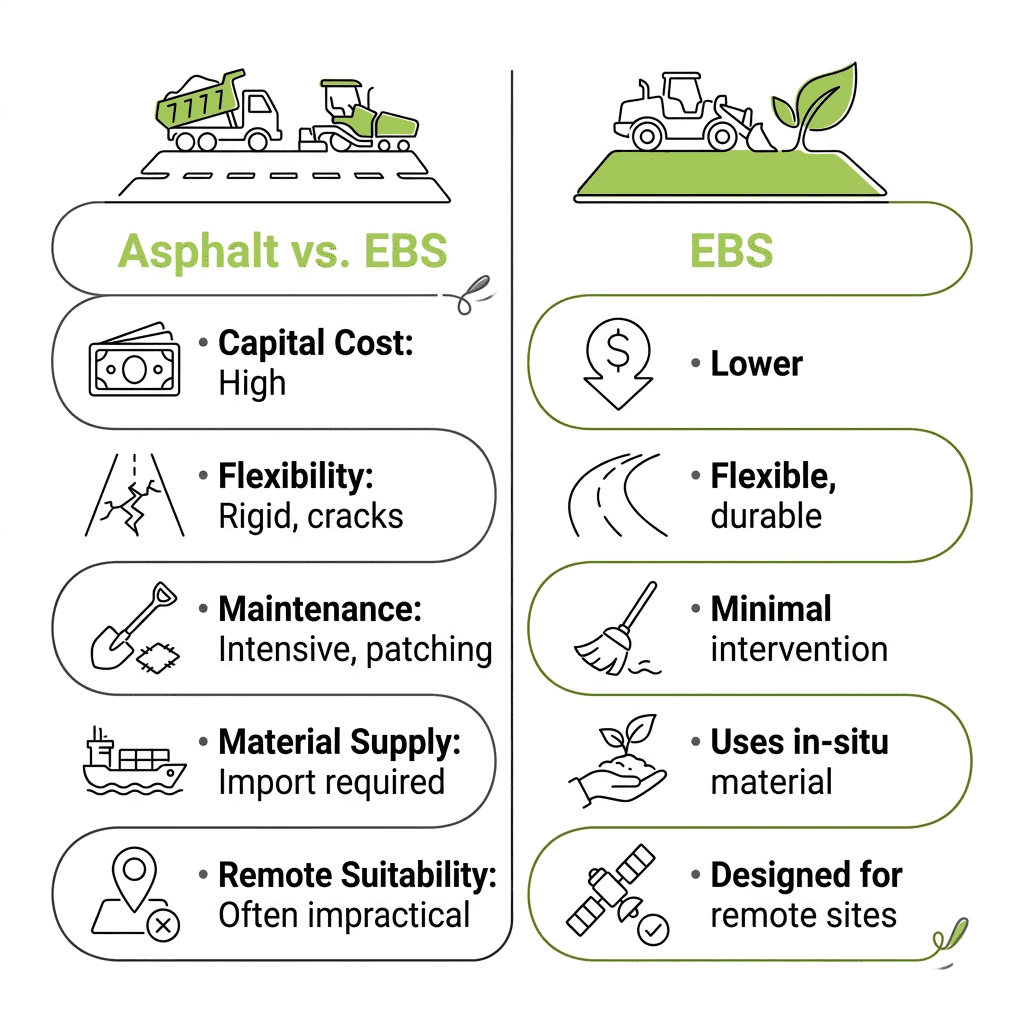
Traditional roads vs the EBS system
| Traditional (gravel / asphalt) | EBS system | |
| Material approach | Imported aggregates, bitumen dependent | In-situ material engineered into the structure |
| Structural behaviour | Unbound, porous, moisture-sensitive | Bound, sealed, water-resistant |
| Maintenance | Continuous grading and watering | Minimal: spot maintenance and periodic resealing |
| Water usage | High (daily dust suppression) | Dust suppression watering eliminated |
| Diesel consumption | High (graders, water trucks) | Significantly reduced |
| Rolling resistance | Increases over time | Reduced and stable |
| Lifecycle cost | Escalating operating costs | Flat, predictable lifecycle cost |
| Environmental impact | High emissions, dust pollution | Reduced CO₂, dust controlled |
Traditional roads consume resources. EBS-engineered roads optimise them.
Surface seal or base stabilisation?
EBS Surface Seal
For gravel roads with sound, well-graded material. Once the road is graded, shaped for drainage and compacted, EBS is applied as a surface seal, creating a hard, water-resistant, dust-free wearing course.
EBS Base Stabilisation
For substandard or weak in-situ materials. Road recyclers and reclaimers mill the existing material and inject EBS, building a stronger, bound base layer that is then sealed.
Construction sequence
- Assess: a Soil Solutions technical manager tests the in-situ materials and site conditions
- Prepare: the road is graded, shaped and contoured for drainage, with stabilisation where the material needs it
- Compact: the layer is compacted to specification
- Seal: EBS is applied as a surface seal, at a dilution set for the material
- Maintain: minor spot maintenance and periodic resealing as recommended, instead of routine grading and watering
Application rates
| Surface seal | 0.35 L/m² EBS |
| Base stabilisation pass | 1.0–1.5 L/m² EBS, depending on material condition |
| Stabilisation plus seal | 1.35–1.85 L/m² total |
| Dilution | Set on site for the material composition |
Final application and dilution rates are recommended for each project after a site assessment.
Specification, quality assurance and maintenance
Our gravel road upgrade programmes for governments and institutions include:
- A structured specification for each road
- Quality assurance and testing during construction
- An integrated maintenance plan for long-term performance
- Skills transfer to local teams
Technical specifications
| Product | EBS (Engineered Base Stabilizer) |
| Type | Eco-friendly, non-toxic, biodegradable stabiliser and surface seal |
| Environment | Does not leach into the soil or water table |
| Surface seal rate | 0.35 L/m² |
| Stabilisation rate | 1.0–1.5 L/m² |
| Finished surface | Hard, water-resistant, dust-free wearing course; natural or black surfaced finish |
| Equipment | Graders, rollers and water bowsers; road recyclers or reclaimers for stabilisation |
Performance depends on material suitability, drainage, traffic and site conditions, confirmed through site assessment.
Working with asphalt roads?
REHABILITATION
Recycle failing asphalt
Recycle cracked asphalt in place with EBS instead of removing and replacing it.
ADDITIVE
Build better new asphalt
Add EBS during production for stronger, longer-lasting asphalt mixes.
Ready to upgrade your gravel roads?
A Soil Solutions technical manager will assess your site and recommend the right treatment.
Request an Assessment